From his first engagement at GE Money, through anonymous prepaid payment cards, all the way to the first fully online consumer loan in Central and Eastern Europe. Oldřich “Olda” Kotas has been at Trask for more than 19 years. He started as a developer and team lead, and today he is responsible for the area of digital channels, moving somewhere between enterprise architecture and business consulting. How has Trask changed over that time, what does the role of an architect look like, and why does he think it makes sense for both junior and senior architects to consider Trask?
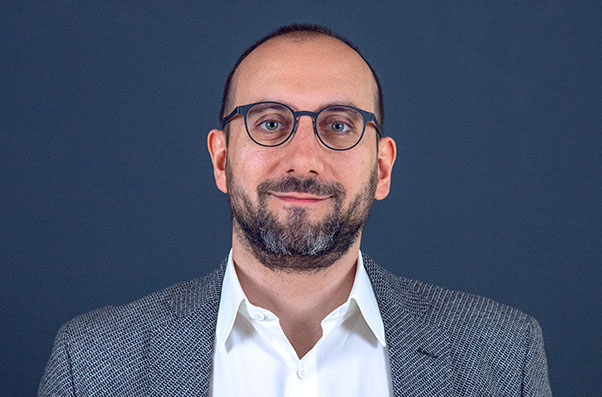
Olda, you’ve been at Trask for more than 19 years. When did it occur to you that this wouldn’t just be one of many jobs, but that you’d actually stay?
I never had that one big moment of revelation. Trask was my first job after school; before that, I only had various part-time gigs. By a coincidence of circumstances and fate, I ended up interviewing with Jiří Soukeník and Nora Kremlíková – I really liked their approach, their humanity, the way they talked about the company. I thought to myself: “Yes, this is where I’d like to work.”
Why did I choose Trask? One of the key differences between Trask and other companies was that at those other interviews, they would say, “Well… you’ll be programming here under supervision for a few years and then maybe we’ll see and you’ll get a junior colleague or two.” And I was fired up and passionate, and I didn’t want to waste time. Trask gave me that wild card.
And then it just took off. I always had luck with people, and there was always some “next wave.” Whenever I felt that one role or area was exhausted, anew opportunity appeared – a different project, a different team, a different topic. And that’s how I’ve been here 19 years.
How did Trask look when you joined, and how do you see it today?
Back then there weren’t even a hundred of us altogether – basically the equivalent of one of today’s larger departments. Trask had a number of core teams and competencies, but only a few people covered them.
Today there’s a company of more than a thousand people standing on top of that – and from one Trask there are now ten or twelve smaller ones, each with a slightly different culture, focus, and way of working.
From my point of view, Trask has changed enormously and at the same time surprisingly little. The scale, processes, and structure have changed. But at its core – in how you can talk to people here, what we dare to take on, and how much it all rests on trust – it’s still very similar.
And of course, people have aged. When I joined, I was about twenty-five and the leadership was ten years older. They seemed to me like “old and experienced gentlemen.” Today I’m over forty, they’re over fifty, and we see the world differently. That naturally changes the culture – from the wilder years with parties until the morning at the beginning, to something a bit “more laidback.”
When you look back at those 19 years, which projects shaped you the most as an architect?
Honestly – I had an interesting, growth-driving project almost every year. But there are definitely a few milestones. One of the first big ones was a project at GE Money Bank (today’s Moneta). Automation on what were then quite unpredictable IBM technologies. It was a really big project for Trask, and only a few of us worked on it. I was responsible for making sure it would actually work.
Only in retrospect did I realize how much trust my bosses placed in me back then, just a few months after I joined the company. It was a great school– technically, in terms of people, and in terms of stress. We then reused that experience several times on other projects. Interesting for me was also the period around prepaid payment cards for a subsidiary of Česká spořitelna. It was the first time I fully saw that we weren’t just doing IT – that regulation, legislation, and a business plan all come into play.
And a big milestone was the “loan without papers” project for Tomáš Salomon– the first fully online consumer loan without physical contact in Central and Eastern Europe. Banking lawyers had always said, “It can’t be done,” but thanks to a combination of our ability to improvise and deliver anything, together with the business and legal expertise of the then team around Pavel Riegger (most of whom are now at Trask), we made it happen. We delivered a real breakthrough that other banks in the Czech Republic and the region gradually copied. This project also kick-started several very intense years of cooperation with consulting firms – and showed me how to open the door from “basement IT” into the boardroom.
Architect at Trask Through the Eyes of Olda Kotas: From Development All the Way to Where the Company and Clients Are Headed
You started as a developer, and today you’re somewhere between enterprise architecture and business. What changed on that journey?
I stopped programming a long time ago. For the last ten years I only occasionally poke at something somewhere or try to help with error analysis.
But it’s not like something snapped overnight. I’ve always naturally leaned that way – I enjoyed thinking more about what the solution does, who it’s for, and what value it brings, rather than about algorithms.
My first area at Trask was process automation and integration – essentially “programming without programming.” You click blocks and arrows, connect systems, but you mostly think about logic and process. Today this would becalled low-code / no-code, but we were doing it twenty years ago.
Even then, Trask wasn’t afraid to be innovative – we were bringing things into the Czech market that no one had done before. And for me, it was a natural bridge from pure development to architecture and a business perspective.
When someone says “architect at Trask”, what should I picture?
“Architect” is almost like saying “employee in a car factory.” It can mean someone on the production line or the head of design. At Trask we have the full spectrum. There are senior developers and team leads who design applications and do software design, but still work with code.
Then there are solution architects – they work on specific client projects, combine functional requirements and technology, and design the solution we need to deliver. Another group are technology and domain gurus – people who are “into integrations,” “into payment cards,” “into documents,” and anything else you can think of. They apply their expertise on projects and with clients, evangelize, and advise on how to do that technology or domain well.
And then there are enterprise architects and business consultants – those who talk to clients about what would help them or what their IT and business should look like in a few years. On projects they help convince clients that we understand their needs and that we bring more added value than a typical IT company.
Today I’m in enterprise architecture, close to business consulting. I will never be a pure business consultant; I’m someone who understands technology and IT management, understands business, and tries to connect the two.
On LinkedIn you write that you’re a bridge between IT and business. What does that look like in practice?
An illustrative scenario: a client comes in wanting to “sell cars via mobile.” They saw it somewhere at a conference; supposedly it works on the other side of the world. My job is to decipher it: What does it mean to sell cars via mobile? How does the process work from the perspective of each participant? Where is value created? Where are the costs? Where are the biggest pitfalls? How quickly will requirements change? What regulations and risks are involved? And so on. And then translate that into IT language so that application owners and eventually developers know what they’re supposed to do.
IT will often tell you, “That’s not possible.” But “not possible” can mean there’s no capacity, they haven’t tried it yet, they don’t want to do it in a system that’s going to change, or that it will take a long time. My task is to translate that back into business language and set expectations – you can have it, but you must choose whether to pay more, wait longer, or do it differently.
I often sit with the client and help them make sense of what they want from their IT, what they actually need, and what is realistically possible.
Why Start as an Architect at Trask: Responsibility, Trust and Room to Grow in Your Own Way
Let’s talk about architects who might be considering Trask. Why, in your opinion, should a junior architect start here?
For me, it’s mainly about responsibility and trust. When a junior joins and seems reasonable, we’ll try them out on whatever is currently at hand. And if they catch on, are motivated, and have an open mind, they can basically get a lot of responsibility right away. That’s what moves you forward – not spending two years looking over someone’s shoulder.
The second thing is, you’re not just a number in Excel here. The people around you genuinely care about what you want to do. If after a year you find that a particular area doesn’t fulfil you, it’s realistic to turn the wheel –go somewhere else, try a different technology, a different type of project.
And the third thing – respect for the fact that no one is perfect. Let’s be honest, we all have some quirk or weakness. Someone doesn’t like public speaking, someone wears camouflage trousers, someone gets up at 10 a.m. We help balance out what’s necessary, while letting people grow in what they’re good at.
But there’s another side to it: Trask is not an institution where you sit, wait, and others bring you tasks and check your study plans. You have to have your own drive here. The opportunities are huge, but you have to go after them.
And what about a senior architect who’s already done a lot? Why might Trask be the right place for them?
For me, there are three main reasons. The first is flexibility and a family-friendly approach. Most senior people have a family, children, other commitments. We’re not an environment where someone forces you to sit from nine to six for formal reasons. The key thing is that the work gets done and is of high quality – and the specific setup can be agreed in a way that works for both sides.
The second is trust. Once we shake hands, we take it for granted that you’re a professional and that you care about doing good work. You get the freedom to do it your way, without micromanagement, without unnecessary KPIs and metrics for the sake of metrics. It’s a partnership, not corporate harassment.
And the third is reasonableness and openness to discussion. Trask is not a rigid corporation with concrete career ladders. A lot of things can be arranged– changing teams, a sabbatical, diving into a different area. But again: it’s for people who have energy, can talk about things, and are willing to take responsibility for their decisions.
What would you say to architects who are considering Trask?
If you want an environment where you can have real impact – on projects, on clients, and on how the company operates – and at the same time be able to talk to people around you like adults, in a friendly and trusting way, then Trask makes sense.
You won’t get a detailed manual here telling you what to do, how to grow, and exactly where you should be in three years. But you will get space, trust, and opportunities. And if you have your own drive, it can become much more than just another job on your CV.

